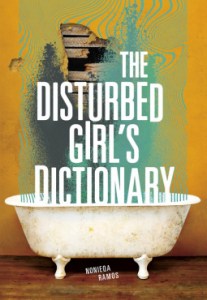
Review: The Disturbed Girl’s Dictionary by NoNieqa Ramos

thedisturbedgirlsdictionaryThe Disturbed Girl’s Dictionary by NoNieqa Ramos

My Rating: 3.5/5 TARDISes

Series: Standalone

Date Published: February 1st, 2018

Publisher: Carolrhoda Books

Pages: 344 pages

Source: Netgalley

Links: Goodreads | Amazon | Book Depository

Synopsis: Macy’s school officially classifies her as “disturbed,” but Macy isn’t interested in how others define her. She’s got more pressing problems: her mom can’t move off the couch, her dad’s in prison, her brother’s been kidnapped by Child Protective Services, and now her best friend isn’t speaking to her. Writing in a dictionary format, Macy explains the world in her own terms—complete with gritty characters and outrageous endeavors. With an honesty that’s both hilarious and fearsome, slowly Macy reveals why she acts out, why she can’t tell her incarcerated father that her mom’s cheating on him, and why her best friend needs protection . . . the kind of protection that involves Macy’s machete.

____________________________________________________________

*I received a copy of this book from the publisher in exchange for an honest review*

I have so many feelings about this book—some that are conflicting—but let me start out by saying that this is a wonderfully diverse novel. It focuses on many topics that I personally have not seen much, particularly in the world of young adult fiction. I found it very hard to collect my thoughts both during and after reading this story because of the quantity of thought-provoking material that is present. While my overall opinions on and experience with this novel were somewhat mixed, that in no way means that I did not truly enjoy reading it.

In this novel, we follow a fifteen-year-old girl named Macy, who is chronicling her life through entries in her own personal dictionary. Macy has been classified as “disturbed” by everyone—including herself—but really, she is just a teenager trying to survive in a horrible situation. Her father’s in prison, her mother treats her terribly and is too busy having multiple affairs to think about the welfare of her children. Macy has little to no food to eat and only a couch to sleep on, and on top of everything, she has just lost her little brother to Child Protective Services. However, Macy is not going down without a fight, and she will do everything she can to prove that she can beat the odds, as well as protect the people she loves the most.

The plot was not at all what I had been expecting going into the novel. Personally, I thought this sounded as if it would be sort of a dark mystery/thriller type story. It is definitely on the dark side, given the nature of the subjects it addresses, but that’s about all that it has in common with what I predicted—it is more of a heartbreakingly realistic, fictional recounting of a person’s life and hardships. This came as a huge surprise, though a good one, as I thoroughly enjoyed the powerful and impactful story that I found within these pages. It took me quite a while to wrap my head around everything that occurred—in a good way.

My absolute favorite part of this novel are the characters—they are beautifully crafted. Whether lovable or despicable, there is absolutely no denying that each and every one is multi-dimensional and highly memorable. Macy is such a wonderful main character and narrator. Her personality is so distinctive and vibrant, and she is someone who is very easy to care about and root for—she is strong, badass, and just plain awesome. Also, out of all the other characters, George is the one that I adored the most.

Ramos uses a writing style that is both very unique and not commonly seen in literature. The uniqueness comes from Macy herself and her personal way of voicing her thoughts. She relates her story using very choppy sentences filled with grammatical errors. This fits her absolutely perfectly, and truly adds a great deal to the way Ramos depicts her. Macy’s views on life have a distinct peculiarity of their own, which also contributes to both the realism and charm of her character.

On a technical level, the style used is most like a stream-of-consciousness narrative, as we follow the events of Macy’s life as they happen. Since Macy is narrating through entries in her dictionary, she is essentially writing out her train of thought. There is a very diary-esque feel to it, and her internal monologue is all over the place, another factor I found added depth and relatability to her as a character.

I will acknowledge, the format in which this novel is presented—stream-of-consciousness coupled with grammatical inaccuracies—may not be the easiest to read. However, Ramos does a fantastic job with it, and the more you read, the better it flows. I thought this stylistic choice suited the novel extremely well—I loved it, and I cannot see any other type of narration relaying Macy’s story as perfectly as this does.

I’m still trying to collect all of my thoughts, partially due to the fact that some of the issues I had with the novel conflict with aspects that a loved. I believe that many of my complaints stem from the style of narration that is used. However, as I said before, that style was absolutely perfect and really brought Macy’s story to life in a way no other type of narrative could have. As you can imagine, this is causing me a lot of difficulty when it comes to reviewing the novel—but I will try my best to explain things as clearly as I can.

Let me preface this by saying that I have absolutely no personal experience with the types of trials and horrors that the characters in this novel have to face on a daily basis. And while I feel as though I learned a lot from reading this, I will never say that I can even begin to understand the pain of being in these situations. The fact that any person, especially a child, should have to deal with these struggles upsets me to no end, and I have the utmost respect for the strength and bravery people have even during the of darkest times.

There were a few times where I struggled to understand certain events in the narrative. Admittedly there were some occasions where it was extremely obvious that the problem was simply my lack of knowledge on certain topics and not at all the actual writing itself. But there were also a number of instances where I felt as though more detail needed to be used in order to clarify what had taken place. This could be explained by the narration style, since a person writing entries in a journalistic way is bound to be less descriptive. Nevertheless, there were times when I wasn’t able to explain what had just happened.

On the other hand, even when I felt unsure of what exactly was happening in a scene, Ramos did such a wonderful job of crafting her characters that it never fully detached me from the narrative. She conveys the emotions so clearly, I could always relate and comprehend on that level, thus allowing me to remain closely connected to everyone. So, while I wish I could have some clarity about those particular events, it was less of a detriment to the plot as a whole than it would have been in most situations.

I also understand that this narrative can be a bit hard to follow and therefore might be a slow read. That is due to both the stream-of-consciousness format—which can make everything feel jumbled and random—and the obvious grammatical errors in Macy’s writing. The main plotline can be a bit tough to find because, having that diary style, the plot is not going to be as linear. Personally, while I did read through this a bit slower that I normally might, I found all of these qualities to be incredibly fitting to the story and Macy’s voice.

One very minor detail—and by minor, I mean I’m just putting far too much thought into things like always—that confused me a bit was the timeline of the novel. It comes across as though Macy is writing each entry in alphabetical order as it happens, since we do follow somewhat of a connected storyline. However, she frequently references other entries in the dictionary, many of which haven’t happened yet. Like I said, this isn’t a huge issue by any means, it just made it a bit unclear to me how exactly events were progressing.

The Disturbed Girl’s Dictionary is a book that I know is going to stick with me for quite a long time. It is an extremely eye-opening and powerful read that addresses many dark but incredibly important topics—ones that are hard to hear about but desperately need to be discussed. The realistic characters and vivid emotions really brought the events to life, and make this story an even more educational experience. I am so glad that I picked this up, and I very highly recommend giving this novel a read.

3.5 TARDISes

logo2

Mini Review: A Beautiful Composition of Broken by r.h. Sin

abeautifulcompositionofbrokenA Beautiful Composition of Broken by r.h. Sin

My Rating: 3/5 TARDISes

Series: Standalone

Date Published: July 25th, 2017

Publisher: Andrews McMeel Publishing

Pages: 480 pages

Source: Netgalley

Links: Goodreads | Amazon | Book Depository

Synopsis: r.h. Sin, bestselling author of the Whiskey, Words & a Shovel series, returns with a collection of poetry and prose meant to remind the wounded that they are, in fact, beautiful in a way society may never comprehend.

A Beautiful Composition of Broken is inspired by some of the events expressed artistically by Samantha King in the bestseller Born to Love, Cursed to Feel. It serves as a poetic documentary of the lives of people who have been mistreated, misunderstood, and wrongfully labeled in a way that limits them in this world. The author’s most personal volume yet, A Beautiful Composition of Broken builds a conceptual bridge between r.h. Sin’s earliest work and his forthcoming series, Planting Gardens in Graves.

____________________________________________________________

*I received a copy of this book from the publisher in exchange for an honest review*

I am so conflicted over this collection of poetry. Having enjoyed the previous two collections of r.h. Sin’s work that I’ve read, I really wanted to love this one. And at first, I was once again pulled in by his words. Unfortunately, my expectations were a bit too high, and I ended up feeling very disappointed by this collection as a whole. The quality writing that I have come to expect from Sin is definitely there, but the power and impact of his words is severely lacking.

The biggest issue that I have with this compilation is how incredibly repetitive it is. At the very beginning, the poems are deceptively unique. They are extremely reminiscent of his previous works, but not so much that they are completely uninteresting to read. However, it quickly goes downhill, as each poem begins to feel like the last—variations of the same exact story. Nothing is inherently bad about the poems themselves—they are still well-written—but the ideas and themes in them repeat to the point of monotony.

This collection feels very much like it is made up of cookie cutter poetry instead of many distinct pieces that come together to form a unified work. Everything ties together, but this is due to the fact that each piece comes across like it is the same exact poem articulated in a different way. It sucks out all of the emotion in the message he is trying to convey through his words, and things begin to feel forced. The poems start feeling cheesy rather than meaningful, and they take on an unappealing hollowness.

There are still plenty of redeemable qualities about r.h. Sin’s poetry, particularly the general beauty of his words. With his talent, I feel as though he could easily do so much better than this. If he varied his topics, even staying within the theme of love, betrayal, and eventual empowerment, this would have been a much more interesting and impactful reading experience. This has caused me to lose some enthusiasm about reading Sin’s work, but I will still be giving some of his other collections a try.

3.0 TARDISes

logo2

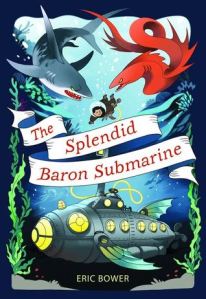
Review: The Splendid Baron Submarine by Eric Bower

thesplendidbaronsubmarineThe Splendid Baron Submarine by Eric Bower

My Rating: 4.5/5 TARDISes

Series: The Bizarre Baron Inventions #2

Date Published: November 7th, 2017

Publisher: Amberjack Publishing

Pages: 244 pages

Source: Publisher

Links: Goodreads | Amazon | Book Depository

Synopsis:Waldo “W.B.” Baron is back with another amazing adventure in another incredible invention! Pirate treasure? A clandestine meeting? A terribly rude monkey with personal boundary and hygiene issues? Two of those things sound like a dream come true to W.B, whose clever inventor parents are hired―by the Vice President!―to go on a super secret and intensely important treasure hunt to repay a national debt. If only it weren’t for that lousy, rude monkey, it would be the beginning of a perfect adventure. But at least it isn’t squirrels…

The treasure hunt gives the Baron family the opportunity to use their exceptional steam-powered submarine, freshly biggened and ready for adventure! But things are seldom straightforward for the eccentric Baron family, and this treasure hunt is no exception. W.B.’s trademark bad luck has him suffering monstrous marine misfortune and marauding monkey misery.

Can the Baron family embark on their newest adventure without the eggy and depressing Aunt Dorcas? Will the Barons find the treasure they seek? Will they save the country from financial ruin? Where does the monkey fit in, anyway? Do we like asking questions? Not really, but inside you’ll meet someone who likes asking questions and then answering them (despite his claims to the contrary, he really does like it).

Oh, did we mention the pirate’s curse?

____________________________________________________________

*I received a copy of this book from the publisher in exchange for an honest review*

This is a spoiler-free review.

After reading and thoroughly enjoy the previous novel, I had no idea that there were going to be any other books following it. So I’m sure you can imagine just how excited I was when this randomly showed up on my doorstep one day. And this new installment did not disappoint—it was equally as hilarious and entertaining as the first Baron adventure. In fact, this plotline is my favorite of the two. Just like the first one, this story is a madcap adventure with the significance of family, friendship, and love at its core.

I fell even more in love with the characters Bower has created for these stories. It is so wonderful to see the new dynamic between them—building on that of the first novel. Even with the many misunderstandings that happen between the members of the Baron family throughout the course of the novel, they still remain tightknit and incredibly loving. This creates an appealing warmth in the tone and atmosphere.

In this novel, the Baron family is approached by the Vice President of the United States, who sends them off on a new adventure—this time at the bottom of the ocean. They have been given the task of tracking down a lost pirate treasure, which will be used to help the government repay a national debt.

Traveling in their steam-powered submarine, W.B. and his family go through another overly complicated journey. We follow them as they run into an enormous amount of outlandish obstacles, many involving W.B.’s usual clumsiness and his feud with a rather mischievous little monkey. However, not all is as it seems. Unsavory forces are at work, and maybe the troubles of their nautical excursion are the least of their problems.

While this is obviously not a deep and thought-provoking read and the target audience is fairly young, it is still so much fun. The characters’ wacky antics and escapades will have you laughing out loud. It is absolutely impossible to read these stories without a smile on your face. I will admit, the humor is not for everyone—older readers may not be as captivated by the childlike nature of it. In addition to that, the events of the story are quite random and jumbled, which does not negatively impact the narrative by any means—it is very fitting for the plot. However, this format is not going to be everyone’s cup of tea.

On the other hand, it is perfect for children—and for some adults, it will entertain the inner child we all have. This is one of those stories that had me wishing it had been around when I was younger. The outlandish nature of the events of the plot is what makes this story so great. One must suspend their disbelief and go along with the far-fetched and preposterous aspects of Bower’s unique version of the past.

The actual text of the novel itself is very easy to fall into and flows extremely well. Bower’s style is unquestionably a style that is appropriately accessible for the intended audience. He does a fantastic job of making the unbelievable believable—an essential part of this narrative. And at no point does it feel like it would be difficult for a child to understand or that it might make them lose interest. This book can be read as a standalone, though I personally feel that reading the series in order works a bit better.

Overall, this novel was equally as entertaining as the previous one, if not even more so. The Splendid Baron Submarine is a fast-paced and universally enjoyable read. Filled with hysterical surprises and humor that is just plain silly, this quirky tale is perfect for people of any age. This is a light and incredibly big-hearted series as a whole, and will undoubtedly pick up your spirits. I highly recommend this series to anyone looking for a warm and cheerful story or something amusing and wholesome for your child to read.

4.5 TARDISes

logo2

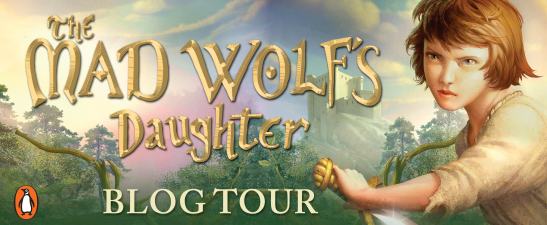
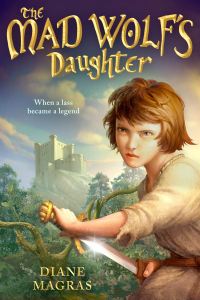
Review: The Mad Wolf’s Daughter by Diane Magras

unnamed-76

unnamed-75The Mad Wolf’s Daughter by Diane Magras

My Rating: 5/5 TARDISes

Series: Mad Wolf’s Daughter #1

Date Published: March 6th, 2018

Publisher: Kathy Dawson Books

Pages: 288 pages

Source: Publisher

Links: Goodreads | Amazon | Book Depository

Synopsis: A Scottish medieval adventure about the youngest in a war-band who must free her family from a castle prison after knights attack her home.

One dark night, Drest’s sheltered life on a remote Scottish headland is shattered when invading knights capture her family, but leave Drest behind. Her father, the Mad Wolf of the North, and her beloved brothers are a fearsome war-band, but now Drest is the only one who can save them. So she starts off on a wild rescue attempt, taking a wounded invader along as a hostage. 

Hunted by a bandit with a dark link to her family’s past, aided by a witch whom she rescues from the stake, Drest travels through unwelcoming villages, desolate forests, and haunted towns. Every time she faces a challenge, her five brothers speak to her in her mind about courage and her role in the war-band. But on her journey, Drest learns that the war-band is legendary for terrorizing the land. If she frees them, they’ll not hesitate to hurt the gentle knight who’s become her friend.

Drest thought that all she wanted was her family back; now she has to wonder what their freedom would really mean. Is she her father’s daughter or is it time to become her own legend?

____________________________________________________________

*I received a copy of this book from the publisher in exchange for an honest review*

This is a spoiler-free review.

This turned out to be quite a charming and enjoyable read. The general concept of the novel is very traditional, but it is spiced up by many unique elements and plot twists that Magras employs throughout. I had such a fun time following the journey of this brave young warrior and her friends. The story mixes danger, mystery, and intrigue with warmth, love, and friendship to create a highly immersive read. With solid characters, a well-written narrative, and plenty of action and adventure, it is incredibly easy to fall in love with this tale.

In this novel, we follow a young Scottish girl named Drest, who’s life is turned upside-down when her father and brothers are captured and taken to the prison at the nearby Faintree Castle. After these knights invade her home, Drest barely escapes the hostility brought upon her family, be she is the only one to do so. Therefore, she is thrown into an unexpected adventure, and must find the courage deep within herself in order to save the ones she loves the most.

Trusting one of the wounded knights to lead her to the castle, she draws strength from the encouraging voices of her five brothers that she hears in her head. Joined early on by a young boy named Tig, the unlikely trio soon become comrades, as they fight through the many perils that lie ahead of them.

However, not everything is as it seems, and the indiscretions of the war-band—her family—are beginning to come to light. This leaves Drest questioning not only who she should put her trust in and whether her family should actually be freed, but also who she is. Despite the obstacles she fights through along the way, the most challenging part of her journey might in fact be at the very end.

I found this to be a very captivating and fast-paced story, and I fell into it very easily. It hooked me right from the start, as we are thrown directly into the action. And the characters were a very high point of the novel. Drest is an incredibly strong heroine and a fantastic model of bravery, both physically and mentally. She develops very realistically throughout the course of the narrative, starting off much more timid and unsure of her abilities and steadily blossoming into a true warrior. A multi-dimensional and dynamic character, Drest is truly the driving force in this novel.

I would have liked to have seen the relationships between the characters developed a bit more than they were, particularly the war-band. We get a fairly good idea of their personalities as the story unfolds, but I think that area could have been focused on slightly more. This was by no means a huge detriment to the story, but I feel as though that would connect the reader even more to the characters, their relationships, and how those elements are tested throughout the narrative.

As far as the writing itself goes, I thought this novel was beautifully written. Magras really has a way with words—everything flowed perfectly and carried me quickly and smoothly through the story. Her writing suits the target age range for this novel so well. She words things very intelligently and clearly. The text is not pared down so far that it comes across as too basic or simple, but it never feels as if it would be too difficult for young readers to understand. She expertly wrote in a style that challenges but would not confuse a middle grade audience.

Magras also does a fantastic job of accurately building the setting of this Scottish headland and beyond. Every detail is not only clearly depicted, everything is very realistic. The backdrop of this story is full of depth and history. In the same vein, the language used feels spot-on for both the time and location, and you can tell the effort and research she put into this aspect of the narrative. The slang used, the way all the characters address one another, it all feels authentic and immerses you deeply in the story. I had no trouble both transporting myself into the world and hearing every line of dialogue with the accompanying Scottish accent.

The Mad Wolf’s Daughter is a very well-crafted and enchanting story of the strength and courage one can find within oneself in the face of adversity. Though it is targeted at a younger audience, I believe that readers of any age will be able to take an interest in this novel. The messages that radiate from this story are very positive and enlightening. It is sure to teach a middle grade reader important lessons about the warrior we all have inside of us. This is full of heart, and is a wonderfully wholesome and exciting fantasy that young readers will surely eat up.

5.0 TARDISes

Author Bio:

15572575Diane Magras grew up on Mount Desert Island in Maine. The Mad Wolf’s Daughter is her debut novel. She is the editor, writer, and chief fund raiser for the Maine Humanities Council.
She volunteers at her son’s school library, and is addicted to tea, toast, castles, legends, and most things medieval. Diane lives in Maine with her husband and son and thinks often of Scotland, where her books are set.

logo2

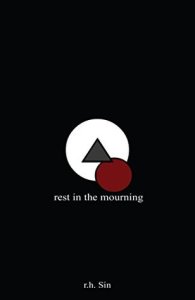
Mini Review: Rest in the Mourning by r.h. Sin

33275462Rest in the Mourning by r.h. Sin

My Rating: 3.5/5 TARDISes

Series: Standalone

Date Published: December 6th, 2016

Publisher: Andrews McMeel Publishing

Pages: 128 pages

Source: Purchased

Links: Goodreads | Amazon | Book Depository

Synopsis: The calm before and after the storm. Rest in the Mourning is a steady and profound stream of conscious thoughts and emotion. Documenting unhealthy relationships and why the heart ends up in the hands of those deemed unworthy. It speaks to the heart’s ability to hold on to relationships that no longer deserve our energy as well as what happens when we are ready to let go. Rest in the Mourning is about self-care and self-love.

____________________________________________________________

This is the second collection of Sin’s poetry that I’ve read and, like Algedonic, I enjoyed it quite a bit. It is formatted in the ever more prevalent style of writing very short poems or simple phrases rather than longer, multiple stanza poetry that most people are used to. It is a particularly tricky style to write well, as that type of poetry can come across as disjointed or shallow more easily than longer poems. However, when it is done well, it can be surprisingly powerful and touching. Though it did not captivate me in the way that Algedonic did, I still had a rather positive experience with Rest in the Mourning.

I have spoken in my other review about r.h. Sin’s talent for writing, and that shines through once again in this collection. His main focus is on the strength of women, but this still makes for a universally relatable read due to his beautiful writing and depiction of the common highs and lows of life. Sin knows how to simplify what can be very complex emotions, and the message he conveys is that of affirmation and strength. Just like the first experience I had with his work, I felt that he did a nice job of focusing on every human’s power to heal themselves in the midst or aftermath of hardship.

However, this collection, compared to his last, was not very unique. Every poem focuses either on women—or, less frequently, on himself—finding their true worth, and removing themselves from toxic relationships. There is nothing inherently wrong with the topic, but I feel that there needs to be some sort of variation, however small. You can still connect your topics together in some way to give the collection as a whole one theme, but I found none of that here. So while the way he worded things was beautiful, overall, every poem felt a little repetitive. I am still interested in reading more of his work, so I definitely will continue to do so.

3.5 TARDISes

logo2

Review: Valley of Time by Jeremy D. Holden

valleyoftimeValley of Time: The Greatest Journey Ever Taken by Jeremy D. Holden

My Rating: 4/5 TARDISes

Series: Mal Thomas Mystery Series #2

Date Published: November 5th, 2017

Publisher: Clean Publishing

Pages: 262 pages

Source: Publisher

Links: Goodreads | Amazon | Book Depository

Synopsis: Fast-paced, full of wit and humor, and sure to delight fans of authors like Carl Hiassen and Nick Hornby, “Valley of Time: The Greatest Journey Ever Taken” is a truly original novel from one of contemporary fiction’s most thrilling new voices. 

Mal Thomas only escaped with his life through a mixture of good fortune and divine intervention, after he and his eclectic team of cynical mad men and women were charged with promoting the alleged second coming of the Messiah, by Alfredo Baptiste, the world’s most powerful industrialist. 

Having subsequently become famous as a best-selling author—as well as an unlikely spiritual leader—after having written and promoted a book about those experiences, Mal is now approached by another enigmatic billionaire with an equally incredible proposition.

Huw Hudson, the man often described as a modern-day Howard Hughes, wants to position his company, Space Rider, as the leader in commercial space tourism. He tries to enlist Mal and his team to help promote it, with one extraordinary twist: Hudson has evidence of an alleged UFO encounter, which he thinks could damage his business plans, and he asks Mal to investigate and manage the breaking news story.

Mal discovers a deeper purpose at work, as he crisscrosses Brazil, Miami, London, and Dubai in furtherance of Hudson’s audacious ambition, while being forced to keep an unbelievable secret from the FBI and even his closest friends. In confronting his deepest fears, Mal takes us on a journey that challenges the very core of our beliefs about space and time.  

In a fast-moving and often sardonic narrative, author Jeremy Holden will have you fascinated by the extraordinary nature of the challenges that Mal and his team find themselves confronted with, as they launch a massive global campaign to promote one of the most seismic events in human history.

“Valley of Time” provides a window into the modern world of digital and social media-driven mass persuasion, while posing this pivotal question: What if you could go back to the pivotal moment in time that shaped your life. Would you try to alter your fate?

____________________________________________________________

*I received a copy of this book from the publisher in exchange for an honest review*

This is a spoiler-free review.

Given how much I enjoyed Sea of Doubt, I eagerly jumped into this novel as soon as I had finished, excited for more adventures with Holden’s very loveable characters. And I was not disappointed in the least—this is a wonderful follow up to the first story. Though I think that I slightly preferred the first story, this one is another fast and extremely entertaining read. And the comedy is superb. Holden knows how to captivate his readers and hold them all the way through the final page. I just have so much fun with his work—I’ve completely fallen in love with it.

In Valley of Time, we are back again to witness another crazy situation Mal finds himself in, as well as to see further examples of the incredible skills he and his entire CREATIF team possess when it comes to advertising outrageous subjects. And this time around, they are presenting an astonishingly major scientific development that will forever change humankind—space tourism.

Huw Hudson, the creator of a company called Space Rider, reaches out to Mal for help promoting his offered space tourism, with the goal of establishing Space Rider as the top company in the world. He also tips Mal off about some alleged evidence of extraterrestrial life popping up around the world. Sworn to secrecy, Mal is put in charge of investigating these reports as well as controlling the portrayal of these stories—and Space Rider’s accomplishments—in the media. As things progress, Mal uncovers a hidden purpose in the background of these events, one that challenges what the world knows about space and time.

At the start of the novel, I was feeling a little bit apprehensive due to the fact that it begins very similarly to the previous story in this series. However, it becomes obvious fairly quickly that the plot is going in a completely unique direction. Once again, Holden’s character depiction and development is top-notch and still my absolute favorite part of these novels. I cannot talk enough about how much I love everyone and how he involves them in the events of the plot. This is a very character driven novel, and those characters are some of the strongest I’ve seen.

Holden’s writing continues to be quite easy to fall in to, and his style of storytelling is highly engaging. He weaves very fascinating and extremely unique plotlines full of adventure and excitement. Just like the previous one, I found this story to be full of surprises, and I never really guessed what was coming next or how things would resolve. Holden manages to turn the very fictional elements into something that feels believable—it’s easy to imagine Mal going through these experiences.

Again, one of the only complaints I have in regards to the writing itself is that there is far more telling rather than showing in this novel. With this particular plot, as opposed to the first novel, that style of narrative slows things down quite a bit more. There is a lot of talk about science and technology, so the story is very description heavy. The balance between this and the action is a bit unequal, and even though I am a huge fan of science fiction and, in particular, anything to do with time travel, even I felt like the narrative got slightly bogged down a few times.

Overall, I thoroughly enjoyed Valley of Time, and continue to love Holden’s plotlines and characters. I’ve heard numerous people say that this novel works as a standalone, and while the plot is unique in itself and does not give away much information about the first book, there are still enough important, potentially vague references made that these stories should really be read in order—I personally feel this would make for the most enjoyable reading experience. As with the first novel, I am extremely glad that I got the chance to read this, and I am very much hoping there will be plenty more installments in this series in the future. I very highly recommend giving these novels a read.

4.0 TARDISes

logo2

Mini Review: Smoke & Mirrors by Michael Faudet

smokeandmirrorsSmoke & Mirrors by Michael Faudet

My Rating: 2.5/5 TARDISes

Series: Standalone

Date Published: November 14th, 2017

Publisher: Andrews McMeel Publishing

Pages: 240 pages

Source: Netgalley

Links: Goodreads | Amazon | Book Depository

Synopsis: Smoke & Mirrors is the third book from internationally bestselling poet Michael Faudet, author of Bitter Sweet Love and Dirty Pretty Things—both finalists in the 2016 and 2015 Goodreads Readers Choice Awards.

Michael Faudet’s latest book takes the reader on an emotionally charged journey, exploring the joys of falling madly in love and the melancholy world of the brokenhearted. Beautifully captured in poetry, prose, and short stories, Faudet’s whimsical and sometimes erotic writing has captured the hearts and minds of thousands of readers from around the world.

____________________________________________________________

*I received a copy of this book from the publisher in exchange for an honest review*

Smoke & Mirrors was just one of those collections that did not click with me. The quality of writing and the messages being conveyed were not completely lost on me. The poems were generally comprehendible, and I was able to immerse myself in the work enough to get through to the end—but that was about it. At times, Faudet’s style was quite off-putting, and that caused a massive disconnect for me and blocked out any important ideas and themes. I found nothing really stood out, nothing touched me or had the impact that the author clearly intended his writing to have.

This collection as a whole does not seem like it would be easily accessible to a wide variety of readers. To me, these poems were not very poetic. The poems that had more of that proclaimed “whimsy” to them were the ones that I enjoyed the most. There were displays of love, heartbreak, happiness, and loss. These poems spoke to me—they were subjects I could connect to—and he phrased these topics in a beautiful way. Through the very beginning of this collected work, I felt much more engaged.

But then, many of the other poems in the next two thirds or so seemed very rough and graphic, taking away any lyrical aspects of the writing. Part way through the collection, the subject matter shifts abruptly into much more mature topics, which in itself is not an issue at all—poetry deals with all sorts of topics, from basic emotions to the more intimate aspects of life. The trouble I had was with the way he worded these things. I just found myself feeling uncomfortable, sometimes verging on disgusted. Again though, this is my personal opinion—definitely not a reflection of how everything comes across to every reader.

I read many positive reviews of Faudet’s work prior to picking this collection up, and I can see how his subject matter and use of language would appeal to some people. His subject matter and voice are, like most poets, very singular and attract different types of readers. This particularly came across as a very niche style—the way he portrays his thoughts and feelings is very unique and very direct. However, his writing was just not for me, and I don’t think I will be picking up any of his other collections in the future.

2.5 TARDISes

logo2

Mini Review: Songs With Our Eyes Closed by Tyler Kent White

songswithoureyesclosedSongs With Our Eyes Closed by Tyler Kent White

My Rating: 5/5 TARDISes

Series: Standalone

Date Published: January 30th, 2018

Publisher: Andrews McMeel Publishing

Pages: 192 pages

Source: Netgalley

Links: Goodreads | Amazon | Book Depository

Synopsis: A collection of Tyler Kent White’s powerful poems about love, loss, depression, and resilience. “Never apologize for burning too brightly, or for collapsing into yourself every night. That is how galaxies are made.” – Tyler Kent White

Many of the poems included here are short and uplifting, with messages such as “be yourself,” “you are beautiful,” and “this too shall pass.” They combine the appeal of short, shareable poems with inspiration and encouragement. Also included are some of White’s lengthier, prose-poetic pieces, which address his childhood, his relationship with his father, and past romantic relationships, among other things. Whatever the form, White takes inspiration from the everyday, writing about abstract topics like love, loss, depression, and resilience using concrete, relatable details and scenes.

____________________________________________________________

*I received a copy of this book from the publisher in exchange for an honest review*

I found this poetry collection to be beautiful and extremely well written. Songs With Our Eyes Closed is another example of a recently very popular style of writing—short but impactful poetry and prose. This is a format where a positive outcome is hard to accomplish, and it is definitely not a format that suites the tastes of all readers nor the abilities and voices of all poets. And it’s very true that this type of writing can easily come across as shallow, random, and repetitive. However, I find that this can also be an incredibly powerful and meaningful way to convey many emotions—that was definitely the case for this particular collection.

White’s writing is full of both beauty and sincerity. Even the shortest poems always feel that they were given an equal amount of time. effort, and detail, and did not lack the emotional depth and maturity of longer poems. He shows a great deal of candor as well as creativity, mixing human emotions with vivid and artistic imagery taken from our world and the universe we live in.

White packs this collection with plenty of affirmations, calling us to look at ourselves in a different and more loving way. The language and topics themselves are easily accessible for anyone, whether they are poetry lovers or not—it could also serve as a fantastic introduction into the world of poetry for a first time reader.

As always, poetry is hard to review as it is such a personal experience, and what I took away from this collection is not what everyone is going to take away. However, this is a very well-written work that skillfully captures truly human emotions that each and every one of us has felt or will feel at some point in our lives, ranging from the joy of love to the pain of loss. His words really spoke to me and related so well to where I am in my life and what I have been feeling, whether those words were reflecting my emotions or pushing me into a more positive mindset.

It is very touching and brimming with honesty and earnestness—never feeling rushed or lacking complexity, even in the most straightforward phrases. White has a very lyrical style that flows effortlessly from line to line and is very pleasant to read. I would highly recommend giving this collection a try.

5.0 TARDISes

logo2

Review: The Crown Jewel Mystery by Anna Elliot

thecrownjewelmysteryThe Crown Jewel Mystery by Anna Elliot

My Rating: 4/5 TARDISes

Series: Sherlock Holmes and Lucy James Mysteries #4

Date Published: June 1st, 2017

Publisher: Charles Veley

Pages: 100 pages

Source: Netgalley

Links: Goodreads | Amazon

Synopsis: A young American actress arrives in London hoping to learn her identity, just as Sherlock Holmes is closing in on a master criminal. Their worlds collide, and not even Holmes could have foreseen the impact!

This novella is the prequel to The Sherlock Holmes and Lucy James Mystery series. It takes place three days before the opening of The Last Moriarty.

____________________________________________________________

*I received a copy of this book from the publisher in exchange for an honest review*

This is a spoiler-free review.

Again, I have been pleasantly surprised by another installment of this series. This is only a short novella—a prequel to the main series—but it is just as thrilling and suspenseful as the full length novels. In fact, I think this is my favorite story so far; it is incredibly captivating and full of surprises that will keep readers on their toes. We are able to go back and take a look at the origins of our characters and what eventually brings them together. It does a wonderful job of further developing backstories and fleshing out many basic aspects of the general series plotline.

In this novella, we primarily follow the perspective of Lucy James, the intelligent, brave, and witty young woman who serves as the main character in the previous novel. Lucy and her friend, Johnny Rockefeller, have just arrived in London in pursuit of the answers that have been hidden from Lucy all her life—who her family is and who has been financially supporting her all through her early years. While following a major lead, the pair suddenly find themselves embroiled in a dangerous con, one with far more twists and turns than anyone can imagine.

I had such a great time reading this story. Though they do not actually meet at this point, it is interesting to see how close Lucy comes to meeting Sherlock. They each play a crucial part in solving this mystery and bringing about justice without even knowing the other’s involvement.

Once again, we get a vivid picture of what an incredibly clever and strong heroine Lucy is. She fits in fairly easily among these other well-known characters, which adds to the plausibility of the narrative when compared against the original stories. Lucy is a very well-developed, multi-dimensional character, who holds her own and makes a solid protagonist for these novels.

Occasionally, Lucy comes across as being just a little too perfect. I always feel that one of the main elements that makes Holmes so incredible is the portrayal of his flaws that remind you he is human. This is an extremely minor complaint though—one that does not negatively affect this novella at all. It is only a point that would add even more dimension to Lucy if used.

Really the main issue that I had is essentially the same one that I had with the previous novel—I still struggle with Lucy’s familial connection to Holmes. This is absolutely nothing that Elliot did wrong; I think she does a fantastic job of making the idea of their relationship realistic and believable. However, I personally am overly picky when it comes to adding elements that really stray far from the original story to a generally faithful retelling. And I admit, the more I read from this series, the more that aspect of the plot grows on me, which is a testament to how well Elliot weaves her characters into the world of these classic tales.

Overall, this novella is a fantastic addition to the Sherlock Holmes and Lucy James Mysteries series. It is a very fun, fast-paced read that also adds more dimension to the series as a whole. We are able to see what finally brought Lucy into the paths of Holmes and Watson, as well as an early picture of her astounding powers of deduction. Though I still do have a few personal issues reconciling the details of her link to the great detective, she is a skillfully crafted mirror of him, while also retaining those things that make her a unique character in her own right. I am loving this series so far and I cannot wait to continue on with it.

4.0 TARDISes

logo2

Review: Futura by Jordan Phillips

futuraFutura by Jordan Phillips

My Rating: 1.5/5 TARDISes

Series: Standalone

Date Published: January 2nd, 2018

Publisher: CreateSpace Independent Publishing Platform

Pages: 72 pages

Source: Publisher

Links: Goodreads | Amazon

Synopsis: By the year 2050, Paris is a stark contrast from other large cities, which had long ago morphed into ultramodern metropolises, where every new building was practically a city within a city. Even in France, humans cannot escape the fact that the Invisibles have taken over. Some come in the form of microscopic chips that are embedded practically everywhere, while others are more visible because they power robots. Humans were suddenly underutilized, and they would be forever.

Past futurists had cried that this would be disorienting and depressing, but it turned out to be quite liberating. Human qualities—good and bad—are tolerated because they are authentic, and not artificially created. To err is to be human, and these days, to be human is to be beautiful. 

Futura follows a single American woman named Ruby as she figures out how to thrive in a dramatically different cultural landscape. This utopian novella pushes back on the cynical views many hold today. Instead, author Jordan Phillips has imagined a bright future for the entire human race.

____________________________________________________________

*I received a copy of this book from the publisher in exchange for an honest review*

This is a spoiler-free review.

I had a rather complex experience with this particular novella. First of all, the actual e-book edition that I received was very messed up and extremely hard to comprehend—the paragraphs were not at all in order. A few paragraphs would fit together, but all of a sudden, the last sentence would stop in the middle, and the next paragraph would be a completely different part of the story. Then, later on, I would find the continuation of those previously unfinished paragraphs mixed in with an entirely new part of the plot. Understandably, this was quite confusing and very difficult to follow since I had to piece together random parts until I had the whole story.

Keeping that in mind, I will try to summarize and review this novella as well as I can. This story takes place in Paris, starting during the year 2050. Society has completely evolved into a highly futuristic, technology-ruled world where artificial intelligence is in charge of most of the goings on from day to day. With the “Invisibles” running things, humans have become very underutilized—but this might not be an entirely awful thing. Instead of the typical pessimistic view of a future run by computers, this novella paints a picture of a world in which people have ample time to spend their lives doing whatever they love.

Every last aspect of the world and its economy is run so flawlessly that everyone is taken care of whether they are employed or not. And employment is simply a choice, not a necessity. Amid all the modernizations, major technological advances, and the microchips that hide everywhere, smoothly running the world, lies a surprisingly utopic human existence. They have enormous amounts of free time, but never lack something to do. Being human is seen as being utterly beautiful—every human quality is accepted. Against all odds, this future is incredibly bright.

It’s been very tricky getting my thoughts straight about this novella. The one thing that I can say is that Jordan Phillips is definitely a talented writer. She did a wonderful job of building the world, using vivid details to capture just how technology takes the pressure off humans without rendering them pointless—without erasing everything that we need to build a life. This is a unique take on life in the future, seemingly far removed from the many horror stories featuring the elimination of our existence. Every element of the plot showed her creativity and inventiveness, and her writing itself was very easy to understand.

Excluding the incomprehensibility due to the formatting of the actual e-book itself, I’m not sure how I feel about the story as a whole. I enjoyed imagining this vision of the future and thinking about all of Phillips’ genre-bending ideas. However, I was left wondering if this was actually as much of a utopian society as it claims to be.

In a world like this, people are much more trapped—things run smoothly so no one steps outside the boundaries or looks to shake things up. It could be looked at as a comfortable and free existence, but would we really be free if we handed absolutely everything over to systems of artificial intelligence? I’m not sure if this story is intentionally posing that question or if I am just overthinking things.

We do loosely follow various characters throughout this story, particularly an American woman named Ruby. She is a single woman looking for love and feeling a strong urge to have a child. It is hard to connect with Ruby, or any of the other characters for that matter, since we spend such a short time with them, and there really is not much in the way of character development happening. I originally liked Ruby, but by the end she was starting to get on my nerves.

About halfway through, she begins making some absolutely terrible decisions, mainly due to the fact that she is so fixated on having a baby. Many of her friends have children, and she sees this as one of the biggest pieces missing from her life. This is understandable—as I’m sure many people feel that way at some point—but Ruby is way too over-the-top about it.

By the end, Ruby makes what I feel is a completely inexcusable choice. It was a bit hard for me to connect with her in the beginning, but she had definitely lost me completely by the end. Along with this, it just seemed like everyone had an outrageously cynical and unhealthy view of many of the important and uniquely human parts of our existence.

So, overall, I got the message that this utopian society was in fact still in the same vein as many of the post-apocalyptic or negative depictions of the future; it just didn’t feel like that much changed for the better. Comparatively, it is better in some aspects, but it is also wholly stifling and still utterly dependent on technology—much more so than today. Again, I’m not sure if this is the intended view the reader is supposed to have or if it’s just how the story came across to me.

In the end, I think this story was unique and well-written, but it simply fell a bit flat for me. This wasn’t really my cup of tea, but it is a quick read and I definitely still recommend giving it a try.

1.5 TARDISes

logo2