Review: The Grownup by Gillian Flynn

thegrownupThe Grownup by Gillian Flynn

My Rating: 4.5/5 TARDISes

Series: Standalone

Date Published: November 5th, 2015

Publisher: Weidenfeld & Nicholson

Pages: 80 pages

Source: Purchased

Links: Goodreads | Amazon | Book Depository

Synopsis: A young woman is making a living, faking it as a cut-price psychic working at Spiritual Palms (with some illegal soft-core sex work on the side). She makes a decent wage – mostly by telling people what they want to hear. But then she meets Susan Burke. Susan moved to the city one year ago with her husband and 15-year old stepson Miles. They live in a Victorian house called Carterhook Manor, built in 1893. Susan has become convinced that some malevolent spirit is inhabiting their home, and taking possession of the stepson. She has even found trickles of blood on the wall. The young woman doesn’t believe in exorcism or the supernatural, but she does see an opportunity to make a lot of money. However when she enters the house for the first time, and meets Miles, she begins to feel it too, as if the very house is watching her, waiting, biding its time….

____________________________________________________________________

This is a spoiler-free review.

For me, it is extremely challenging to write a review on any of Gillian Flynn’s work without an excessive amount of excitement and an inability to get my thoughts straight. Her stories constantly leave me in a state of shock, both at her complex, meticulously plotted story lines as well as her beautiful and skillful writing itself. This woman has an unbelievable talent for the written word and the construction of unique and multidimensional thrillers that stick in one’s mind long after turning the final page.

Throughout the course of this story, we follow the nameless protagonist, a young woman making a living as a fake psychic, as well as practicing some questionable backroom work on the side. She is a very classic Gillian Flynn female protagonist, emerging from a dark past into a gray present. Flawed yet strong, and quite talented at manipulation, she is one of those characters that will do anything in her power to get want she wants, regardless of how her actions affect others. She has a flair for the dramatic and an aptitude for inspiring trust from others.

One day, a very distraught woman named Susan arrives for psychic counseling. Believing not only that spirits have invaded her house, Carterhook Manor, but that they are also attacking her incredibly disturbed stepson, Miles, she employs our main character to cleanse the house.

Of course, our main character has no actual ability to help this family, but seeing this as a way to rake in some extra money while having to do very minimal work, she is unable to pass up the opportunity. However, she ends up getting a lot more than she bargained for. After a series of harrowing events at the house, she finds herself beginning to believe in Susan’s outlandish fears, and tries her hardest to save the family from whatever harmful forces might be at work there.

The writing, the intricate and twisted plotting, the vivid characterization, as always, are all absolutely stellar. Though this story is very much classic Gillian Flynn material, in certain ways it has a bit of a different quality to it than some of her other work. I found that it sort of felt like some of the old psychological thriller films that I enjoy watching—with a modern twist to it, of course. It is unclear for a while what direction Flynn plans on taking the story—what genre she will be focusing on—and that adds yet another layer of mystery for the reader. And when questions are answered, when that mystery fully unfolds, Flynn once again leaves us all shocked and breathless.

The ending is really the only aspect of this story that I have slightly more mixed feelings on. That is not specifically due to the fact that it is an open ending in general—I typically love a well-written open ending, provided it fits solidly into the story as a whole. It is perfectly possible to feel satisfied without knowing exactly what happened after the final pages of a novel, and to be given the chance to imagine your own conclusion or further events. In my opinion, the idea of using an open ending definitely works well and seems appropriate given the overall plot and feeling of this story. However, there is just something a bit off about the one that Flynn presents us with.

This storyline wraps up far too abruptly—it is surprising, but too rushed for my taste. I think my main issue with the ending stems from the fact that it comes across as entirely too much of a twist. It is absolutely fantastic when a book shocks you with something completely unexpected, but it has to be at least somewhat coherent in the context of the rest of the plot. The sudden revelations here seem to be a bit jammed in, come completely out of left field, and are just slightly too far-fetched. It was as if I had fallen into a completely different story in the final pages. So, while it is clear that it is intended to leave the reader in amazement and suspense—and it did completely stun me—it left me a little too unsatisfied and confused.

Overall, I thoroughly enjoyed this story, and it was beautiful display of why Gillian Flynn is one of my all-time favorite writers. She is a brilliant storyteller who, time and time again, completely nails the mystery and psychological thriller genres. A master at crafting complex plots and intriguing characters with dark tales, she excels at captivating her readers and holding them in an iron grip until the final word. Though I might not recommend this for a first experience with Gillian Flynn’s work, I would very highly recommend giving this a read if you have enjoyed her novels.

4.5 TARDISes

logo2

Review: Aimless Love by Billy Collins

aimlessloveAimless Love by Billy Collins

My Rating: 5/5 TARDISes

Series: Standalone

Date Published: October 22nd, 2013

Publisher: Random House

Pages: 288 pages

Source: Purchased

Links: Goodreads | Amazon | Book Depository

Synopsis: The first volume of New and Selected poetry in twelve years from the two-time Poet Laureate of the United States.

Aimless Love gives the reader an opportunity to assess the rich scope of Collins’ gifts. Containing more than fifty new poems and a generous gathering from his collections of the past decade-Horoscopes for the Dead, Ballistics, The Trouble with Poetry, and Nine HorsesAimless Love showcases the best of his poetic maneuvers: the everyday ends in the infinite, playfulness is paired with empathy, irony gives way to wonder. Possessed of a unique voice that is at once plain and melodic, Billy Collins has managed to enrich American poetry while greatly widening the circle of its audience.

____________________________________________________________________

This is a very different sort of review from what I am used to writing. There is no plot to discuss, no characters to analyze—this is something much more indefinite. It is more brief and personal; a plethora of short narratives that unravel differently for each pair of eyes that fall on them. Poetry is an incredibly powerful and emotional type of writing, one that is far more open to individual interpretation than any other. Every work holds a different meaning—touches us all in a singular way—depending on who and where we are. It is challenging to evaluate something so intensely subjective, but I feel the need to recommend this particular experience.

Billy Collins has had a very long and distinguished career in writing. He served as Poet Laureate of the United States from 2001 to 2003 and as Poet Laureate for the State of New York from 2004 to 2006. This particular collection is compiled of selected poems from Collins’ four most recently published books, with an additional section of his newest, previously unpublished work.

Very simply put, Billy Collins has a remarkable way with words. This was my first experience with his work, and just a few poems in, he had already secured a spot has one of my favorite poets of all time—definitely my favorite contemporary one. I am a massive fan of poetry—both reading and writing it—but I have rarely been so completely fascinated by one collection.

The great intelligence and perceptiveness in his words, as well as his unusual and highly intriguing view of the world, make for a captivating read. He has an uncanny knack for writing in a deceptively simple way. On the outside, many of his poems are seemingly very straightforward, focusing on mundane aspects of life and the world around us. However, dive into them and you will be struck with the true depth contained within the stanzas.

Collins’ writing is easily comprehensible, and the subjects he focuses on are exceedingly relatable, which opens his work up to a wide audience. Addressing all of his topics with a very wry tone, a great deal of wittiness, and an eclectic troupe of narrators, he achieves a perfect balance of both humor and earnestness. He tells stories about the smaller aspects of life—the little nooks and crannies of both the physical world and the human mind that often times go unnoticed.

What he accomplishes is a slowing in the pace of the reader’s world, followed by a gradual magnification of life on the periphery of our daily vision and the transient moments that can be lost on us completely. We are made to look at common events, issues, and emotions through an utterly unique lens. Every reader will come away from his poems with a revitalized view of their world and a deeper appreciation for that which is taken for granted or deemed inconsequential to our existence. Collins’ ability to so eloquently and successfully capture these details is astonishing.

The format of this collection makes it an absolutely wonderful introduction for those who have no prior experience with his writing. In a single book, we are given a condensed overview of over a decade of his life in poetry. Though his career is much more prolific than what can be summed up in a few hundred pages, we are able to get a taste for what it has been like—how his writing has grown and changed, and what has remained consistent throughout the years. All in all, it shows his distinctive, inspiring, and constantly engaging style.

I feel the need to point out once again that every reader’s feelings about this type of work will be incredibly unique and individual given the nature of poetry as a medium. For me personally, I truly connected with the writing and themes displayed throughout these pages. However, I believe that no matter what a reader does or doesn’t get from these poems, the extraordinary talent and mastery of language displayed by Collins is something everyone can appreciate. I cannot recommend his work—and this collection in particular—highly enough.

5.0 TARDISes

logo2

Review: A Little Something Different by Sandy Hall
alittlesomethingdifferentA Little Something Different by Sandy Hall

My Rating: 2/5 TARDISes

Series: Standalone

Date Published: August 26th, 2014

Publisher: Swoon Reads

Pages: 272 pages

Source: Purchased

Links: Goodreads | Amazon | Book Depository

Synopsis: The distinctive new crowdsourced publishing imprint Swoon Reads proudly presents its first published novel—an irresistibly sweet romance between two college students told from 14 different viewpoints.

The creative writing teacher, the delivery guy, the local Starbucks baristas, his best friend, her roommate, and the squirrel in the park all have one thing in common—they believe that Gabe and Lea should get together. Lea and Gabe are in the same creative writing class. They get the same pop culture references, order the same Chinese food, and hang out in the same places. Unfortunately, Lea is reserved, Gabe has issues, and despite their initial mutual crush, it looks like they are never going to work things out. 

But somehow even when nothing is going on, something is happening between them, and everyone can see it. Their creative writing teacher pushes them together. The baristas at Starbucks watch their relationship like a TV show. Their bus driver tells his wife about them. The waitress at the diner automatically seats them together. Even the squirrel who lives on the college green believes in their relationship.  

Surely Gabe and Lea will figure out that they are meant to be together….

____________________________________________________________________

This is a spoiler-free review.

As the title suggests, this novel promises its readers “a little something different”, and it does in fact deliver. However, the end result was not nearly as satisfying as it could have been given the premise. Rather than flowing nicely as one continuous narrative, it felt far too disjointed and cluttered to fully capture my attention. We are pulled in by an idea that sounds delightful and heartwarming, but ends up being more frustrating and tedious than anything. Though the story is unique and innovative in many ways, it fell rather flat for me as a whole.

This novel follows the lives of two college students—Lea and Gabe—as they meet and slowly begin to fall for each other. The catch? Their entire love story is told from the perspectives of other people they encounter in their daily lives. From their best friends to their fellow students and the waitress at the local diner, everyone has something to say about this prospective relationship. Even the park bench they regularly sit on weighs in on the situation. The only question that remains is whether or not Lea and Gabe themselves will realize what everyone else already sees.

Beginning on a personal side note, this is not the typical type of novel I would read—I am not particularly big on contemporary romance. But when I heard the concept for it, coupled with the fact that it was a debut novel, I thought it would be a perfect opportunity to step out of my reading comfort zone once again. Given that romance is not my cup of tea when it comes to books, and knowing that this contributed to my feelings overall, I tried to rate and review this as objectively as possible, focusing primarily on stylistic elements.

The characterization was by far the area that I ended up having the biggest conflict with. It was the most publicized aspect of this particular novel—the unusually large number of perspectives is the primary attraction for the reader. In addition, the fact that the main protagonists of the story do not contribute their viewpoints is another highly intriguing factor. However, though the idea packs the novel with originality and is quite fascinating in theory, it ends up greatly hindering the development of the narrative.

Though the actual concept for the plot is a relatively straightforward one, having so many narrators suddenly transforms it into something that is quite difficult to follow and become immersed in. Having to constantly transition between speakers every few pages breaks up the flow of the plot and gives it a very patchwork, choppy quality, which does not serve it well. It is far too challenging to connect to any of the characters, which subsequently affects the reader’s ability to become invested in the storyline itself.

For a story that relies so heavily on characterization, there is not nearly enough distinctiveness in each of the voices. A few of them were quite original in their depiction, but many sounded almost exactly the same. As there is no time to focus on getting to know any of these characters, they come across as one-dimensional and sometimes painfully stereotypical. The inability to get to know a narrator adds undesired hurdles for any reader.

In terms of the plot itself, I simply came out of it feeling rather underwhelmed. One of the biggest drawbacks of these multiple perspectives is the need for more telling rather than showing. This style makes to so that every aspect of every event has to be related back to the reader, giving the story a very awkward and unnatural quality. I would have much preferred to see the romance unfold naturally—instead, it plays out more like a research paper or case study. It is tricky to get the desired emotional reaction out of readers when they can only hear a formal and impassive version of two people’s love story.

Since we are only ever able to see Lea’s and Gabe’s interactions when it is possible for a third party to be watching, everything quickly becomes very redundant—there is an excessive amount of interpretations of the same or similar encounters. Their entire relationship comes across as two people who feel very indifferent about each other having an improbable series of supposedly romantic and incredibly frustrating near misses. This causes the story to drag on, bringing about a sense that, even by the end, no advancement has really happened.

In addition, the fact that every aspect of this novel focuses on Lea and Gabe with no other developed side plots becomes tiring very quickly. It is hard to believe that so many people would be so intensely and utterly focused and invested in the love lives of these two random kids. And even after all of that, I never truly got the impression that they were meant to be. Despite having insight into so many people’s views, I never saw what any of them saw. Everything was just too implausible, and the ending left me feeling very unsatisfied.

Overall, though the large number of perspectives is an interesting concept, it makes the narrative feel very disorganized and unsettled. The repetitiveness of the events in the plot quickly becomes frustrating, potentially causing the reader to become dissatisfied since it feels that little to no progression is actually taking place. I truly did appreciate the creativity that Hall employed in the construction of this story. In a number of ways, she puts a fresh spin on the typical contemporary romance novel, and I applaud how she stepped out on a limb with her inventive storytelling. Sadly, all the parts did not end up coming together into a cohesive plot.

2.0 TARDISes

logo2

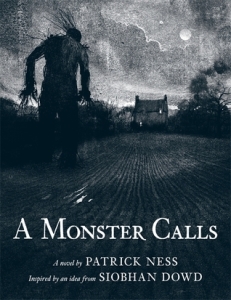
Review: A Monster Calls by Patrick Ness
amonstercallsA Monster Calls by Patrick Ness
My Rating: 5/5 TARDISes

Series: Standalone

Date Published: May 5th, 2011

Publisher: Walker Books

Pages: 215 pages

Source: Library

Links: Goodreads | Amazon | Book Depository

Synopsis: The monster showed up after midnight. As they do.

But it isn’t the monster Conor’s been expecting. He’s been expecting the one from his nightmare, the one he’s had nearly every night since his mother started her treatments, the one with the darkness and the wind and the screaming…

This monster is something different, though. Something ancient, something wild. And it wants the most dangerous thing of all from Conor.

It wants the truth.

____________________________________________________________________

This is a spoiler-free review.

No matter how hard I try, I am never going to be able to sufficiently capture my love for this book in words. Simply put, this novel is completely and utterly beautiful. It was not at all what I was expecting when I picked it up, but it took me completely by surprise in the best of ways. It is a novel that is intensely thought-provoking and unexpectedly haunting. Heartbreaking and deeply moving, A Monster Calls is a captivating picture of love, loss and, ultimately, hope.

In this novel, we follow a young boy named Conor, who wakes from his recurring nightmare one evening to discover a monster at his window—not the one from his nightmares, but the yew tree from the backyard. He faces it with bravery, as he has far more frightening things in his life vying for his attention. But this monster is persistent, returning to him multiple times, bringing a new story with each visit and only hoping to yield one thing. The monster knows Conor is hiding something from everyone and expects him to be the one to tell the last story, finally revealing the truth he is so desperate to avoid.

a-monster-calls-illustration-_thumb

As I have said, the story ended up being far different than what I had originally been anticipating when I discovered this novel—and I am so glad that it was. It was chilling in unique and unexpected ways that had me glued to every page. The narrative is rooted in an intriguing combination of psychological and supernatural elements, while also maintaining a great deal of realism.

The plot, first and foremost, consists of the monster’s visitations and the discussions he and Conor have. Given the realistic nature of the setting and other scenes, with any other novel, a reader might be inclined to immediately dismiss these occurrences as delusions. However, the way Ness writes this aspect of the story is extremely clever—there is a great deal of believability to it. After each encounter, we are left wondering about the actuality of this monster. It is a question that adds great complexity to the plot, and haunts until the final pages.

Ness uses a seemingly paranormal experience to portray the real-life struggle that Conor is going through. He pays homage to the tangibility of grief—how, many times, grief can feel like a concrete, physical being. He also touches on the sort of surreal façade life seems to put on in the midst of pain and sadness. We get to see how a shared pain manifests in different people, demonstrating the similarities and dissimilarities in the way human beings experience and handle a common emotion.

This psychological aspect of the story is what impacted me the most. We have all faced that moment in our lives when we realize that monsters exist in our world, though not in the forms we believed them to take when we were children. We can even feel like monsters are living inside of us when pain controls our thoughts, or possibly when light is shed on the truths we try so hard to conceal. The truth can make us question our morality, our humanity. Conor is being thrust into this awareness at such a young age and this, along with the reason for it, makes the story all the more poignant.

This novel holds some of the most stellar writing that I have ever come across—Patrick Ness is a true master of the written word. His prose is full of such exceptional beauty, and flows fluidly and poetically all the way through. Everything about his writing is enormously compelling. It is simple, yet vivid, forceful, and most importantly, highly effective and engaging. I devoured every word.

Ness makes you think sincerely about your own life, the grief you have experienced and the way you dealt with it. He has a knack for evoking strong emotions and making the reader feel utterly vulnerable and completely human. He also does justice to the complexities of profound sadness with the candor of his writing, never once letting the text feel emotionally manipulative and thus taking away from the earnestness of the story. This novel touched me in a greater way than any other novel ever has.

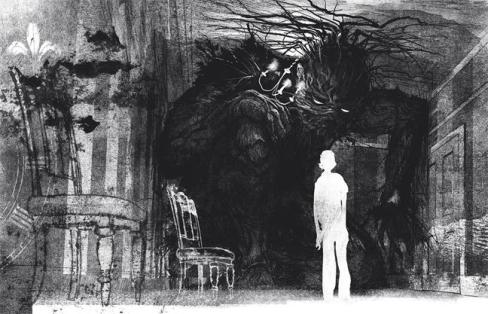
Jim Kay’s illustrations are done to perfection, and further add a vast amount of depth and life to the narrative. They weave seamlessly with the text and assist in setting the eerie and unnerving tone. Though the palette is simple—consisting of blacks, whites, and grays—the effect it creates is anything but. The stark contrast between light and dark gives the images a penetratingly bleak feel. The surreal and sketch-like design contributes to the frightening atmosphere, particularly when the realistic is juxtaposed with the bizarre. As a whole, the end result is unbelievably powerful.

Patrick-Ness-Quelques-minutes-apres-minuit-03

A Monster Calls is an enthralling story that packs an emotional punch and does not disappoint. This novel has become one of my favorites of all time, and has placed Patrick Ness solidly among my favorite authors as well. The plot and the characters stick with you, making this a difficult story to get off your mind when coupled with the already mentally stimulating nature of the themes and text itself.

It is a dark and incredibly heartbreaking story, but also very touching in many ways—Ness completely nails that balance. I genuinely cannot think of any issues that I had with it—it was a true five star read for me. He has created an absolute masterpiece that delves skillfully into one of the most relatable aspects of human life. If you have not picked it up yet, please do. I cannot recommend this novel highly enough.

5.0 TARDISes

logo2

Review: Vicious by V.E. Schwab

viciousVicious by V.E. Schwab

My Rating: 5/5 TARDISes

Series: Villains #1

Date Published: September 24th, 2013

Publisher: Tor Books

Pages: 340 pages

Source: Purchased

Links: Goodreads | Amazon | Book Depository

Synopsis: Victor and Eli started out as college roommates—brilliant, arrogant, lonely boys who recognized the same sharpness and ambition in each other. In their senior year, a shared research interest in adrenaline, near-death experiences, and seemingly supernatural events reveals an intriguing possibility: that under the right conditions, someone could develop extraordinary abilities. But when their thesis moves from the academic to the experimental, things go horribly wrong. Ten years later, Victor breaks out of prison, determined to catch up to his old friend (now foe), aided by a young girl whose reserved nature obscures a stunning ability. Meanwhile, Eli is on a mission to eradicate every other super-powered person that he can find—aside from his sidekick, an enigmatic woman with an unbreakable will. Armed with terrible power on both sides, driven by the memory of betrayal and loss, the archnemeses have set a course for revenge—but who will be left alive at the end?

____________________________________________________________________

I read this in a buddy read with Heather from The Sassy Book Geek. I had an incredibly fun time discussing this book with her, and I absolutely can’t wait to do this again in the future. Click here to check out Heather’s review of Vicious!

I am finding it extremely difficult to come up with the right words to accurately describe just how much I adored this novel. I completed it well over a month ago and I am still constantly thinking about it. This was my first experience with Victoria Schwab’s work, and I was completely blown away by her talent. It has been quite a while since I was so quickly pulled into a novel. I found this incredibly hard to put down once I started reading; it’s one of those stories where you sit down to read a chapter or two and, before you know it, you’ve read a third of the book. This is due primarily to Schwab’s impressive abilities in character development and storytelling.

Vicious follows the story of two best friends turned archnemeses, with a narrative that jumps between the present day and their time in college together ten years prior. During their study of extraordinary abilities, things get out of control, landing Victor in prison, bent on getting revenge, and Eli attempting to wipe out every super-powered person in existence. In alternating time periods and perspectives, the story of their falling out is gradually filled in, and the mystery pieced together in a fast-paced and suspenseful way.

Victoria Schwab is an absolutely brilliant writer with an incredibly addicting writing style that flows beautifully. Her innovative ideas, particularly in the depiction of the super-human abilities, make a well-loved topic into a remarkable and unique reading experience. It is extremely difficult to base a story around villainous characters and requires major skill—which she clearly has—to do so. She is spot on with her level of detail and description when it comes to her world and character building, and she masterfully creates a dark, chilling mood and atmosphere all the way through. Her words, her details, her plot points, everything just flows so nicely.

Early on, I had my doubts about the way the novel jumped around in time so often. That is something I typically do not enjoy, as I have found that I tend to get lost and confused easily in books that skip around too much. However, this did not happen at all as I was reading this book, and I actually ended up loving the style. In general, this can be a rather dangerous and risky way to write a novel, but Schwab executes it perfectly and completely nails this method of storytelling.

Since the plot is so connected to the past and the history of the characters, being able to jump back and hear first-hand what happened to them definitely contributes a lot to the novel as a whole. Schwab does this in a way where she essentially creates two storylines—a past one and a present one—and the jumping between them alternately causes tension and suspense in both. There is also plenty of suspense within each chapter to boot. All of this really succeeds in fully immersing the reader in the story and making them want to read on.

The character creation and development is one of the strongest and most important aspects of this novel, and is definitely some of the best I have ever come across. This is not your typical tale of good versus evil—in fact, what makes this story so intriguing is the lack of clarity and specificity when it comes to the definitions of both. It is a novel about villains, revenge, and the dangers of extreme power. The characterization relies heavily on moral ambiguity, and no one is truly heroic in the traditional sense of the word; there is typically an ulterior motive behind each character’s actions.

Schwab works hard to create vivid and complex characters, and she presents the reader with a comprehensive portrayal of every single one. This is one of my personal favorite elements to see in a story. Clearly displaying a character’s good qualities as well as their flaws will always make for a far more memorable and three-dimensional character that your reader will take an interest in. And whether they are hero or villain, this connection is essential. No matter what side their loyalties lie on, every character needs to be relatable in order to have an impact on an audience. 

Vicious contains a very flawed group of individuals, and none of their negative qualities are sugar-coated. Their flaws are a driving force in the plot. This is the type of story that requires messed up and imperfect characters—ones who are not distinctly good or bad and whose motives are questionable. That is exactly what she has succeeded in creating here, and it adds a great amount of depth to the story. Whether you like them or not, they are utterly fascinating, and you find yourself fully captivated by their plotlines, constantly wanting to know more.

This book is filled with many magnificent examples of antiheroes, and what comes from this is an absolutely enthralling character study. Victor is one of the most amazingly well-imagined characters I have ever read about in my life. His characterization was brilliantly done, and his storyline was absorbing from the very first page. He is that villain that you hate to love, and potentially even love to hate—and though his actions are not always entirely permissible due to his focus on revenge, you find yourself siding with and rooting for him anyway. Overall, Victor is a surprisingly relatable and likeable villain, and an impeccable choice for a main protagonist. He was by far my favorite character in the novel.

On the opposite side of this, from the very first time we see Eli and Victor together, something about Eli immediately rubbed me the wrong way—and as the story progressed, my opinion of him most definitely did not improve. Though he is an intensely dislikable character, his plotline was fantastically well executed. Schwab wrote it in an incredibly interesting way, making it one of those stories where, depending on one’s point of view or position, Eli might not necessarily be a villain in everyone’s eyes.

As a reader, we are meant to feel that he is entirely immoral. His actions are not at all condonable, nor is there any justification for anything he does. And we as the reader are correct in thinking this, because his inhumane actions are not and should not be justifiable; he is a monster. However, it is also easy to understand why he justifies his own actions to himself.

Eli believes that he is doing right, that he is being heroic and fulfilling God’s will, and it would be impossible for anyone working under that type of extreme delusion to see their own—or potentially someone else’s—immorality. While neither Eli or Victor are truly heroes, Eli’s delusion of heroism and inability to see his own inhumanity makes him not only more villainous, but also far more dangerous.

Victor is much more aware of what he is doing and, though he does questionable things primarily for his own motives, that is not the definition of all of his actions. He has far more restraint and humanity left in him—more of a conscience than Eli has. There are certain actions each do individually that it would be hard imagining the other doing. Victor is certainly more aware of the consequences of his actions, and though that might not prevent him from ever doing evil, he has limits and never has any misconception about his purpose in life.

Schwab also fills this book with an all-star set of secondary characters. Sydney is a downright lovely character, and by far the most purely endearing and innocent of the bunch. On top of this, the role that she played in the story was fascinating, and her powers were an element that served to create a lot of mystery and suspense throughout. Another character that added to the huge amount of suspense in the plot was Mitch. Mitch is one of the only other truly lovable characters in the novel, and the juxtaposition of his natural talents against the others’ powers was a highlight for me.

Serena falls more toward the Eli side of the scale of villains. She is quite dislikable from the very start, and while she remains that way throughout the novel, you begin to understand her actions as more information about her is revealed. As with Eli, it is impossible to condone what she does, but you do begin to get an understanding of how aspects of her life—such as her powers—would cause her to act in the way that she does. All in all, though these three are all supporting characters, they are no less vivid or complex than the protagonists, and their plotlines are fully conceived.

Victoria Schwab has produced an absolute masterpiece with this novel. Her three-dimensional characters and unique plotlines work together to create a truly engrossing and addictive read that will stay with you long after you’ve finished it. Whether or not you are a superhero/supervillain fan like myself, this book holds something for everyone to enjoy. If you have not read this yet, I very highly recommend giving it a go. I’m not sure what to expect from the sequel, but I’m definitely looking forward to seeing what happens next; I cannot wait to be back in this world with these characters. Vicious, without a doubt, now holds a place on my list of all-time favorite novels.

5.0 TARDISes

logo2

Review: Doctor Who: System Wipe by Oli Smith

doctorwhosystemwipeDoctor Who: System Wipe by Oli Smith

My Rating: 2.5/5 TARDISes

Series: Standalone

Date Published: November 19th, 2015

Publisher: Penguin Random House UK

Pages: 160 pages

Source: Netgalley

Links: Goodreads | Amazon | Book Depository

Synopsis: The Doctor finds himself trapped in the virtual world of Parallife. As he tries to save the inhabitants from being destroyed by a deadly virus, Amy and Rory must fight to keep the Doctor’s body in the real world safe from the mysterious entity known as Legacy . . .

____________________________________________________________________

*I received a copy of this book from the publisher in exchange for an honest review*

This is a spoiler-free review.

In this story, the Doctor, Amy, and Rory find themselves in 2222 A.D.—the end of the world, or one ending at least. When investigating a sole source of power in a completely empty and decimated Chicago, the Doctor enters and becomes trapped in the virtual world of Parallife. Here, the characters, who have been left behind by their players, have developed minds of their own and created a society. However, their way of life is threatened as a darkness approaches, wiping out everything in its path. Meanwhile, Amy and Rory have to escape destruction themselves, as a horde of robots move in to demolish what is left of the city.

I am rather conflicted in my feelings about this book. The concept for it was so interesting and would have easily made a fantastic episode of the television series. The idea of a virtual world controlled by abandoned characters who have each developed a consciousness holds an incredible amount of potential. Throw in a force that is systematically destroying that world and you have what should be a unique and intense ride.

This was a story that I desperately wanted to love, but I was very dissatisfied with a lot of it. I found this novel was lacking the suspense and intrigue that is characteristic of the Doctor’s adventures. I expected far more excitement than I got, and I ended up disconnecting from the story frequently. There were so many missed opportunities to create apprehension for the reader in both the real and virtual settings, and this caused me to have trouble becoming invested in any of it. I believe that part of it was due to the fact that this is not a full length novel. The concept of this plot is far too massive for the size of the story it was squeezed into.

Another of the main aspects of this novel that I had very mixed feelings about was the character depiction. Due to the length of the story, Smith is not given very much time to get the reader familiar with new characters. Despite this, he manages to create an intriguing and likeable cast that complement the story well. I thought that Blondie was a very good imagining of a video game character come to life. She was relatable because she acted in ways that any gamer would immediately recognize. Daryl was definitely my favorite addition. He was adorable and hilarious and very reminiscent of the type of side character typically seen in episodes of the show.

On the other hand, the depiction of the main trio left me a bit disappointed. I personally did not feel that Smith accurately portrayed these three characters that we all know so well. Something was off about them all the way through. Their actions and dialogue clashed with the personalities of the original television show versions, and that ended up breaking my immersion in the story. The characterization of the Doctor, Amy, and Rory is arguably the most important part of a novel like this, but unfortunately, I thought this was an area that Smith did not succeed in.

The writing itself was another aspect of the story that has caused me to have some mixed feelings. A lot of the writing is strong—Smith’s descriptions are fairly vivid and detailed, at least in the first half. At the start, I had a clear image of both the real and virtual worlds in my mind as I read. I enjoyed a lot of what Smith created, particularly in the world of Parallife.

However, I started to have some difficulty later on in the story. About halfway in, the imagery became a bit muddled for me, and I frequently struggled to make sense of it. This was frustrating, as I found that I could not sufficiently picture anything that was occurring. I also felt as though Smith did not take full advantage of the whole concept of the virtual world—it lacked the intrigue that I expected from it. While he described Parallife well, he did not utilize it to create a solid amount of suspense and tension in the plot.

Despite the negative reaction I had to a number of things in this novel, every once in a while, there was something thrown in that would make me love it. There were moments of great humor that made me laugh out loud. There were references that gamers like myself, especially fans of open world RPGs, could easily connect with and that made my nerdy self very happy. These things really pulled me back in and kept me going to the last pages.

In the end, though the concept for the plot was intriguing, the story as a whole ended up falling a bit flat for me. There were some ideas that I really loved, but the actual execution of those ideas left a lot to be desired. A story as short as this is always going to provide obstacles for the author in terms of building a world and carrying out a storyline, and I definitely think the length is the cause of a number of the issues I had with it. Overall, this was not a terrible book by any means. It could have been better, but even with the problems I had with it, I still found it to be a relatively entertaining read at times.

2.5 TARDISes

logo2

Review: Doctor Who: Death Riders by Justin Richards

doctorwhodeathridersDoctor Who: Death Riders by Justin Richards

My Rating: 3.5/5 TARDISes

Series: Standalone

Date Published: November 19th, 2015

Publisher: Penguin Random House UK

Pages: 160 pages

Source: Netgalley

Links: Goodreads | Amazon | Book Depository

Synopsis: The Galactic Fair has arrived on the mining asteroid of Stanalan and anticipation is building around the construction of the fair’s most popular attraction – the Death Ride! But there is something sinister going on behind all the fun of the fair; people are mysteriously dying in the Off-Limits tunnels. Join the Doctor, Amy and Rory as they investigate…

*I received a copy of this book from the publisher in exchange for an honest review*

____________________________________________________________________

This is a spoiler-free review.

The Doctor, Amy, and Rory land on Stanalan—an asteroid used for mining—which, as they soon find out, contains an entire civilization. The caretaker, Perpetual Pete, who has been there far longer than anyone living on Stanalan can even remember, has marked some of the old mining tunnels as Off-Limits. He claims that they require maintenance, says they are liable to collapse, and forbids anyone from traveling down them. With the arrival of the Galactic Fair and the construction of an attraction called the Death Ride, Pete has his hands full attempting to keep the workers from building parts of the ride’s track in those tunnels. However, people begin to turn up dead in those Off-Limits areas, appearing to have died from something far worse than collapsing walls.

I found the plot to be fairly predictable, but that did not take away from my enjoyment of it. Richards did a wonderful job of building intrigue and tension in the opening chapters of the novel. He unveiled the important details at the right pace to create the tense and mysterious atmosphere that the story required. I do wish there had been a bit more use of the Doctor, but given the length of the story, I thought there was a decent balance in the attention given to each character; each member of the trio contributed an equal amount to the progression of the plot. There were times that the story felt a bit choppy or like it was jumping a bit too quickly over certain aspects, but those sacrifices are to be expected in a shorter novel, and I felt that Richards handled it well.

I definitely felt that the first half of the story was a lot stronger than the second half. The ending was quite clunky and had me shaking my head on numerous occasions. It seemed like it was trying to be fairly typical of a conclusion to an episode of the show. However, they had gotten into such a predicament that there was very little that could be done to avoid a “deus ex machina” sort of situation. Though my suspension of disbelief is pretty good for Doctor Who in general, this ending was maybe just a tiny bit too farfetched even for that.

I enjoyed the author’s writing style quite a bit; it was easy to follow and flowed very nicely. His descriptions were very detailed and clear, and I was easily able to picture all of the settings and characters in my mind. Richards did a great job of building up an image of a bleak world slightly brightened by the presence of this fair. Yet behind that, he creates an underlying sense of tension and mystery, even before the unexplained deaths actually begin to occur.

The only complaint I had in terms of the writing might simply be caused by differences in location and subsequently dialect for me. Throughout the entire story, every single time the word “around” was used, Richards exchanged that with “round”. This is something that I am accustomed to hearing used in speech, so its use in lines of dialogue felt appropriate. Until this novel, however, I have not seen it employed in regular lines of text, such as in descriptions, and it felt quite out of place in those instances. Frankly, the constant substitution began to feel rather repetitive and awkward. As I said though, this may just be a question of dialect and writing style that I am not entirely familiar with given my location compared to the author.

Richards did a solid job of accurately capturing the personalities of the Eleventh Doctor, Amy, and Rory. Their deliveries of dialogue as well as their interactions with each other were spot on. This was a short novel, so there was not nearly as much time available for the author to flush out the supporting characters. Richards still managed to do a good job of vividly portraying them and their interactions with the main trio. The fact that he worked everything together so well so quickly served to make the novel feel even more reminiscent of an episode of the show.

The main complaint I had in terms of the characters was that I occasionally felt that Amy was acting out of character, and I found that to be a bit frustrating. There were times when she sounded like herself but felt like a different person. A number of times, I questioned why she was acting in certain ways because those actions did not match the true intelligence of her character. Despite that, the characterization in this novel was truly a high point for me.

Overall, this was a very fun and quick read that definitely did the characters and the television series justice. Like the show itself, there is limited time to develop plot and characters in a story of this length, and I liked how much that made it feel like watching an episode. Despite being out of the target age range and not entirely loving the ending, this was still very satisfying and enjoyable to read. This is a story that Whovians of any age will enjoy.

3.5 TARDISes

logo2

Review: Nimona by Noelle Stevenson

nimonaNimona by Noelle Stevenson

My Rating: 5/5 TARDISes

Series: Standalone

Date Published: May 12th, 2015

Publisher: HarperTeen

Pages: 266 pages

Source: Library

Links: Goodreads | Amazon | Book Depository

Synopsis: Nemeses! Dragons! Science! Symbolism! All these and more await in this brilliantly subversive, sharply irreverent epic from Noelle Stevenson. Featuring an exclusive epilogue not seen in the web comic, along with bonus conceptual sketches and revised pages throughout, this gorgeous full-color graphic novel is perfect for the legions of fans of the web comic and is sure to win Noelle many new ones. 

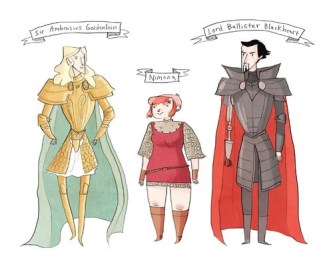
Nimona is an impulsive young shapeshifter with a knack for villainy. Lord Ballister Blackheart is a villain with a vendetta. As sidekick and supervillain, Nimona and Lord Blackheart are about to wreak some serious havoc. Their mission: prove to the kingdom that Sir Ambrosius Goldenloin and his buddies at the Institution of Law Enforcement and Heroics aren’t the heroes everyone thinks they are. 

But as small acts of mischief escalate into a vicious battle, Lord Blackheart realizes that Nimona’s powers are as murky and mysterious as her past. And her unpredictable wild side might be more dangerous than he is willing to admit.

____________________________________________________________________

This is a spoiler-free review.

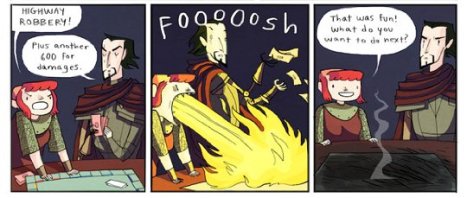
This was my first experience with Noelle Stevenson’s work and I was completely blown away by her talent. Nimona started out as an award-winning, serialized web comic that was published as a full graphic novel; Stevenson does both the artwork and the writing for it. Given the theme of super villains, I knew right away that I was probably going to enjoy this story. I did not, however, expect to love it nearly as much as I did. The plot, the characters, the art—everything met and exceeded all of my expectations.

I first discovered Noelle Stevenson and Nimona a few months ago through watching Booktube, and I am extremely glad that I did. Finding out that she writes and illustrates her own graphic novels was something that instantly intrigued me. I have always loved the idea of an author being able to do the artwork that corresponds with their text. That personal touch not only allows the illustrations to flow more seamlessly with the words, but it gives the most accurate possible depiction of what is going on in the author’s mind. This can be particularly captivating when it comes to this medium, as it relies so heavily on the visual aspect, and this was definitely true of this novel.

15601214

The story itself has a perfect mixture of hilarious and heartwarming moments, and it is completely packed with witty humor. There was also a deepness and complexity to the plot that I was not originally expecting to get out of it. To me, this felt like a sort of caricature of the types of stories where the villains are not entirely evil and the supposed “good guys” are not truly the heroes.

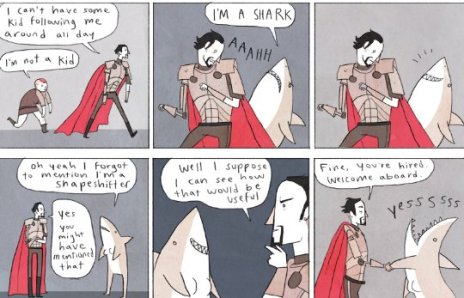
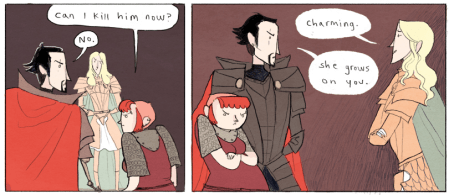
It stars the notorious, not so villainous super villain, Ballister Blackheart, and his reckless new shape-shifting sidekick, Nimona. Nimona’s main mission is to make Ballister into a better super villain so they can cause as much general destruction as possible. On the other hand, Ballister’s main goal is to prove that his friend turned nemesis, Sir Ambrosius Goldenloin, and the Institution of Law Enforcement and Heroics are far more corrupt than people realize. Ballister is, in fact, quite against creating havoc, and steadfastly refuses to hurt or kill anyone. Obviously, delightfully hysterical shenanigans ensue.

nimona2

All of the characters in this story are extremely interesting and wonderfully endearing. The relationship between Ballister and Nimona is lovely. She has sort of forced herself into the position of sidekick, and she does a lot of things that he does not always approve of. But they take care of one another, and you can see very clearly just how much they care about each other. Together, they make a great—and only moderately destructive—team. Ballister and Ambrosius’s relationship is beautiful and done to perfection. I really appreciated how Stevenson fluidly works their romance into the plot without making a huge fuss about it; it feels perfectly normal and accepted, as it should.

16249420._SX540_

The best part to me about reviewing a graphic novel is that I get to talk about the artwork, which, in this novel, was absolutely fantastic. The style was colorful and comical, fitting absolutely flawlessly with the themes in and tone of the plot. I loved the fact that she designed her work more like sketches, focusing less on having thorough detailing. The composition of the text itself had a very handwritten feel to it, and matched the overall style nicely. The entire graphic novel was solidly constructed as a whole, and made for an incredibly entertaining reading experience.

16249418._SX540_

I cannot recommend this highly enough, particularly if you are new to graphic novels. I am relatively new to them myself, as I have only begun reading them in the last year or so and have only read a handful. Nimona was one of my first real experiences with them, and an absolutely magnificent one at that. This story has the perfect mix of comedic and heartfelt moments, and beautiful artwork on top of that. It is a hilarious, fun, and captivating read that will put a smile on your face and leave you feeling good long after you have turned the final page. I am really looking forward to reading more of Noelle Stevenson’s work in the future.

5.0 TARDISes

logo2

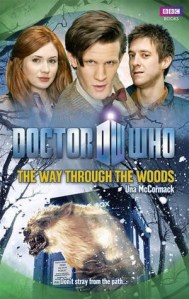
Review: Doctor Who: The Way Through the Woods by Una McCormack

thewaythroughthewoodsDoctor Who: The Way Through the Woods by Una McCormack

My Rating: 4/5 TARDISes

Series: Doctor Who: New Series Adventures #45

Date Published: April 28th, 2011

Publisher: BBC Books

Pages: 241 pages

Source: Library

Links: Goodreads | Amazon | Book Depository

Synopsis: ‘As long as people have lived here, they’ve gone out of their way to avoid the woods…’

 Two teenage girls disappear into an ancient wood, a foreboding and malevolent presence both now and in the past. The modern motorway bends to avoid it, as did the old Roman road. In 1917 the Doctor and Amy are desperate to find out what’s happened to Rory, who’s vanished too. 

But something is waiting for them in the woods. Something that’s been there for thousands of years. Something that is now waking up.

____________________________________________________________________

This is a spoiler-free review.

I have been a Doctor Who fan for a long time now, but I have only discovered this series of novels that connect to the show within the last year or two. Suffice it to say, finding them made me quite excited, particularly because it was during a hiatus between seasons. A few of these stories come out along with each new season and star the current Doctor and companion at that time. Now that I have read through quite a few of these novels, I will say that they definitely tend to be quite hit or miss, most likely due to the multiplicity of authors writing them. However, I am very pleased to say that this one fell into the “hit” category.

Though the Tenth Doctor is my favorite from the television series itself, the Eleventh Doctor novels tend to be my favorites, and this one was no exception. The Way Through the Woods was an incredibly fun read. I thoroughly enjoyed this book and I sped right through it; it is definitely one of my favorite Doctor Who books I have read so far. This is one of the few instances where, as a reader, you truly want a novel to be reminiscent of another work. Since it is based off an already established collection of characters and stories, you do not want it straying too far from what you know and love. I felt that the plot itself was very characteristic of Doctor Who with just enough of the author’s personal touch to make it very satisfying.

I am always a bit wary when the authors of these stories split up the Doctor and his companion(s); this is something that is extremely easy to execute poorly. Not having a good balance between each character’s storyline and the contribution they make to the overall plot can completely ruin a novel. For the most part, I felt that McCormack did a fairly decent job of balancing each character’s time in the limelight, though I do wish that the Doctor himself had played a slightly bigger role.

I liked the intrigue of the plot; it kept me guessing and wanting to know more. There was a very mysterious and sometimes eerie tone and atmosphere in the story that I found to be quite good. The fact that this took place in multiple time periods while retaining a closely connected set of characters was another interesting aspect of this story and added to the overall mystery. I also really enjoyed McCormack’s writing style and the imagery that she produced. I had a very clear picture of all the locations visited by the Doctor, Amy, and Rory, particularly the woods and the location that Amy ends up in near the end.

The author did an excellent job of capturing the Eleventh Doctor, Amy, and Rory individually as well as the interplay between the threesome. McCormack also created a great supporting cast of characters to complement them, and her portrayals of their interactions with the main three were done very well. Of course, one of the most important parts of any Doctor Who story is the alien or aliens causing havoc, and in this novel, I personally thought that the alien was fantastic.

This book was very well crafted, with solid writing and a concept that was very imaginative and creative. Apart from a few instances of awkward dialogue and interaction and an ending that didn’t particularly blow me away, it had a very strong plot. I would have absolutely loved to see this as an actual episode of the show.

I must say, I do tend to rate and review the books in this series on a much different scale than I would with other books, primarily because I do not expect quite as much from them. While these novels are not the greatest works of literature, they are extraordinarily fun to read, and I would highly recommend giving them a try if you are a Doctor Who fan.

4.0 TARDISes

logo2

Review: The Marvels by Brian Selznick

themarvelsThe Marvels by Brian Selznick

My Rating: 4.5/5 TARDISes

Series: Standalone

Date Published: September 15th, 2015

Publisher: Scholastic Press

Pages: 665 pages

Source: Library

Links: Goodreads | Amazon | Book Depository

Synopsis: Two seemingly unrelated stories–one in words, the other in pictures–come together. The illustrated story begins in 1766 with Billy Marvel, the lone survivor of a shipwreck, and charts the adventures of his family of actors over five generations. The prose story opens in 1990 and follows Joseph, who has run away from school to an estranged uncle’s puzzling house in London, where he, along with the reader, must piece together many mysteries.

____________________________________________________________________

This is a spoiler-free review.

The Marvels was an absolutely beautiful gem of a novel that ended up taking me completely by surprise in all the best ways. An intriguing, thought-provoking, and magical tale full of unexpected twists and turns, it captivated me from page one. I am a massive fan of Brian Selznick’s work and have read both of his other novels, The Invention of Hugo Cabret and Wonderstruck. His stories, and the way he tells them with alternating pictures and text, are incredibly unique and gorgeous pieces of art. And though I utterly adored both of the others, The Marvels has surpassed them all.

The format of this novel was quite different from the previous ones. The others had alternating drawings and text, where the drawings either continued where the text left off or told a story in themselves that intertwined with the written story by the end. In The Marvels, Selznick tells two separate stories that take place multiple centuries apart. He begins with nearly four hundred pages of drawings telling one story, followed by two hundred pages of text telling the other. Though this strayed from his usual layout, it served to make the novel even more powerful as a whole.

I was worried at first about the picture aspect of it not being interspersed with text, feeling like it might end up being a bit confusing. However, this was not at all the case, and it was as equally coherent and as emotionally powerful an experience as the actual text itself. There is something very cinematic about that portion, very much like watching a silent film, which tied in brilliantly with the focus on acting and literature in the plot.

This novel is packed with a well-portrayed and memorable cast of characters, all of who are very easy to connect with and feel for. In just a short amount of time, I felt that I had become very attached to them, and was eager to find out how things turned out. This is also a very intelligent read, filled with references to theater and great works of literature, primarily works by Shakespeare and Yeats. A major theme of this novel is how life inspires art, and how art can make aspects of life a bit clearer to us all.

The visual portion of the novel tells the story of a family of actors growing up in the theater and on stage between 1766 and 1900. The text portion begins in 1990, and tells of a young boy named Joseph Jervis, a lover of fiction who is searching for his own real life adventure. Joseph runs away from boarding school to London in order to visit his uncle, Albert Nightingale whom he has never met, and request his help in locating his best friend. When he arrives, he is transported back in time by stepping into the house of a man who lives as if he is from the 1800s. The adventure begins, as Joseph attempts to piece together his family history and see why his uncle is living in such a way.

Going in, I did not know very much at all about this story aside from the relatively vague synopsis provided, and this turned out to be the absolute best way to read it. I was incredibly surprised by the twists and revelations in the plot, and that kept me on the edge of my seat, intrigued to find out the answers to the many mysteries.

This is not a good vs. evil story, not a story with any sort of antagonist. It is a story of people finding their place in the world, writing the story of their own lives and their own futures. It is about love, acceptance, and learning to be patient, with others and with life itself. Most importantly, it is about seeing; looking deeper into a world, fictional or factual, and perceiving that which matters the most.

Selznick sends the reader on a journey of their own, opening a door into the past and inspiring them to take each new fact they learn and explore what they see to decipher the mystery of how the two narratives relate to each other. All of his novels have a winning combination of stunning artwork and skillful writing. He is a magnificent storyteller through both words and images. The drawings allowed me to become fully submersed in the story and the world right from the start. I felt completely transported back in time, and his spot on descriptions of Albert Nightingale’s house made me occasionally forget that we were in the 1990s and not actually the late 1800s.

The pairing of these two mediums, as well as how he weaved the two tales together, made for a thoroughly rich and memorable experience. The story itself and the distinctive way that it is told makes this novel unlike anything I have ever read before. Through his novels, he has created a style that fully immerses the reader in the lives of his characters, and this fresh take on his usual format makes that experience all the more vivid. It was a stunning and breathtaking work, one that fits its title well. This was a truly wonderful journey.

“Aus Visum Aut Non. You either see it or you don’t.”

4.5 TARDISes

logo2